
Pike County Active Warrants Explained
An outstanding warrant is a court order that no record shows as served, recalled, quashed, vacated, or otherwise closed out. Pike County's own offices publish no definition of those labels. That means you read the current docket and agency records in sequence instead of trusting one screen. The pieces live in different places.
Pike Circuit Court carries the county's listed criminal work. Its referee holds local-rule authority to make probable-cause findings and issue arrest or search warrants in criminal matters. The clerk maintains the court record itself. The Pike County Sheriff then receives warrants and executes them as the court directs. Issuing a warrant and serving it are separate acts, and each office can hold a different slice of the file.
No Pike County Warrant Roster
The Pike County Sheriff's site posts no public warrant roster, no warrant-search tile, and no most-wanted or roundup page. That is a fact about the public site, nothing more. It does not mean Pike County has no warrants, and it says nothing about any internal law-enforcement system.
The sheriff does publish several tools. Inmate Search, criminal history requests, bond information, public-record requests, and a tip form all appear on the site. None of them is an active-warrant list. Inmate Search tells you whether someone is in custody. The criminal-history page covers verified arrest and booking information, and it states plainly that it is not the actual criminal record or a charging and outcome record. Each tool answers its own question, so match the tool to what you need.
Key point: The absence of a public Pike County roster changes the search route, not the possible existence of an outstanding warrant.
How Pike County Tracks Active Warrants
With no public Pike County roster, there is no refresh schedule, status legend, or removal rule to describe. Public case information comes through Indiana MyCase. The clerk supplies the official court record, and the sheriff can explain execution, return, custody, and records procedures on their end.
Treat MyCase as a lead, not a verdict. Search by cause number, UTT citation number, or exact legal name. Select Pike Circuit Court and check All, Open, and Closed statuses. Read the event list for failure to appear, warrant, bond revocation, service, recall, release, or a later hearing. Then call the Pike County Clerk at 812-354-6025 to confirm which entry controls now. For service or custody questions, contact the Pike County Sheriff at 812-354-6024. A call to law enforcement can carry consequences, so anyone who may face arrest should speak with an Indiana attorney first.
MyCase Gives a Pike Warrant Lead
The official MyCase help page warns that online information is not the official court record. Older data may be incomplete. Public documents can be absent, and sealed or confidential matters may not appear. MyCase also has no direct warrant-status field. An Open case is not proof of an active warrant, and a Closed label may not explain how an earlier warrant ended. The MyCase search interface lays out the Case, Name, and Attorney search routes without displaying any personal results.
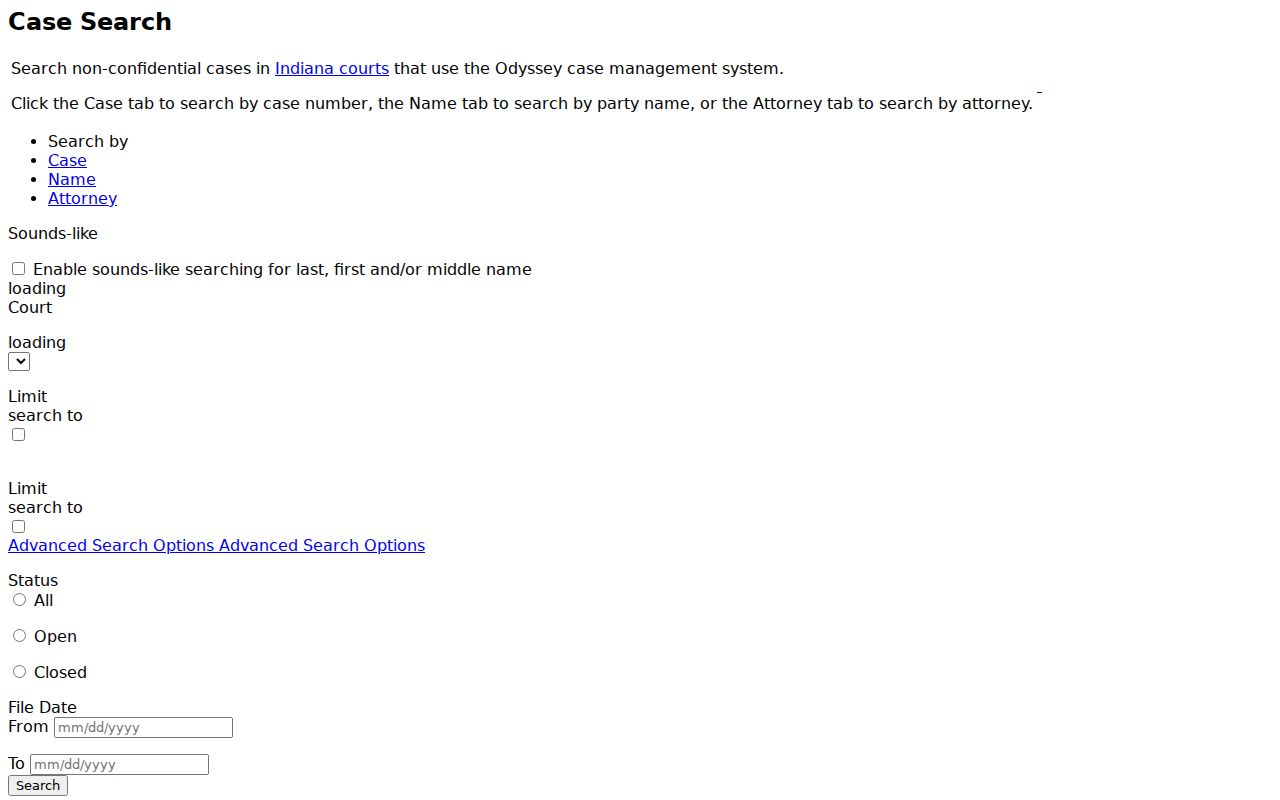
That interface helps you find a docket. Only the Pike County Clerk can confirm the official status and what record exists.
Inside an Active Warrant Record
A Pike County warrant record can include the issuing court, cause number, subject name or description, alleged offense, issue date, probable-cause basis where applicable, the command to arrest, bond, and direction to the sheriff. Later entries may cover service, return, recall, quashing, release, or the next hearing. Public access varies with the record and the case posture.
| Cause number | 63C01-YY-XXXX-000000 connects the order with its case |
|---|---|
| Issuing court | Pike Circuit Court and division or officer when public |
| Alleged offense | Charge context, not a conviction |
| Bond | Amount and conditions set by rule or order |
| Execution or return | Sheriff action that may be held outside MyCase |
| Later court action | Recall, quash, vacate, release, or another hearing |
That field list reflects Indiana law and Pike County local rules, not any named case. No individual's details belong in it.
When Pike Sources Disagree
A MyCase event and a sheriff record can show different stages of the same matter. The court may have entered an order the agency has not yet received or indexed. A service return can sit with the sheriff while the public docket shows only a short event label. Do not resolve a mismatch by guessing which screen is newer.
Work it down step by step. Write down the cause number and the exact event date. Ask the clerk whether a recall, quash, vacate, release, or other signed order exists. Ask the sheriff whether a county execution or return record is available and what identifier staff need. If the case involves traffic failure to appear, check the Indiana BMV consequence separately after the court record is confirmed. Keep filed copies and receipts after any court action. Ask when an order will be transmitted to the sheriff. A payment entry, a future hearing, or a name dropping off a search screen does not by itself establish that an outstanding Pike County warrant has ended.
Warrant Roundups and Most-Wanted Lists
Pike County runs no most-wanted page and no warrant-roundup archive. No amnesty day exists here either. If the sheriff or a court starts one later, check the announcement on an official Pike County domain and read its date and eligibility rules. A most-wanted list is only a chosen few. It never shows every active warrant. A missing name proves nothing. The sheriff's tip form just passes information to investigators. It is not for crimes in progress. Call 911 for those. Nor is the tip form a warrant lookup or a surrender route.
Roster rule: Use only a future verified official Pike County list and never copy its names, photographs, or personal details into another site.
Pike Warrant Status Terms
Pike County paperwork stays plain here. The county leans on arrest warrant and failure-to-appear wording rather than a separate public active-warrant label. Knowing the terms helps you ask the right office without treating a shorthand tag as a legal conclusion.
- Active or outstanding
- A common agency status label, with no Pike public roster definition located.
- Failure to appear
- Missing or not answering a required court event, with consequences set by the case and law.
- Recall, quash, or vacate
- Court action that may alter or end a warrant as stated in the signed order.
- Return
- An agency or court record of execution, service, or nonexecution.
- Sealed or confidential
- A legal access limit that may keep a record from public search results.
Skip the term capias in Pike County. Ask about a warrant of arrest or a failure-to-appear warrant unless the docket itself uses different words.
Pike Outstanding Warrant Access Limits
Indiana has two access laws worth knowing. The Access to Public Records Act covers agency records, while the Indiana Rules on Access to Court Records govern court files. Access Rule 4 grants general public access to court records, subject to listed exclusions. Rule 5 protects sealed matters, investigative requests, confidential filings, juvenile records, and similar material. A search-warrant affidavit may be treated differently from an arrest-warrant event or a service return. Ask for any reasonably segregable non-exempt portions. When a clerk or deputy withholds or redacts something, request the statute, rule, or order behind that call. Court-file access is the clerk's to explain. Sheriff-held records are the sheriff's. The sheriff's public-record request page takes requests by mail or in person and warns that a fee may apply. The sheriff publishes no fixed Pike County fee, so name the execution, service, return, or custody record you want and ask for a cost estimate.
When Your Name Is on the Warrant List
Pike County publishes no public warrant roster. Treat a notice about you as a warrant-related court event, not a roster entry. Save the cause number. Ask the clerk whether the matter is still current. Avoid posting the record or letting an unofficial site interpret it for you. A lawyer can discuss the court, a possible motion, an appearance, bond, or surrender. Only the issuing court can recall, quash, or vacate a warrant. The sheriff cannot be counted on to cancel a judicial order on his own. Paying through a bond channel does not prove the warrant has cleared. Confirm the exact amount and terms, watch for a later court order, and ask when it reaches the sheriff.
- Identify the Pike Circuit Court cause number.
- Confirm the official docket with the clerk.
- Speak with counsel about custody risk and court options.
- Follow the court's case-specific direction.
- Keep proof and verify later transmission or disposition.
The Pike County warrant records overview provides the broader resolution and bond context.