
Searching for a Warrant in Pike County
Start at Indiana MyCase. It is the statewide public case-search entry point. It is not a live warrant database. With a cause number, citation number, or cross-reference number, use the Case tab. Without a number, search the correct legal name and select Pike Circuit Court. Check All, Open, and Closed statuses rather than treating an Open case as proof of an active warrant. Then confirm the result with the Pike County Clerk at 812-354-6025 or Circuit Court at 812-354-6026. The clerk can explain the public docket and record access, but cannot give legal advice. For execution, return, custody, or sheriff-held records, call the Pike County Sheriff at 812-354-6024. If arrest is possible, talk to an Indiana lawyer before calling law enforcement or appearing in person.
- Gather the cause number, UTT citation number, or accurate legal name.
- Search MyCase with Pike Circuit Court selected.
- Read the event list and orders, not just the caption.
- Confirm the current official docket with the clerk.
- Route service or custody questions to the sheriff.
Why Pike Has No One-Click Warrant Lookup
Pike County has no one-click warrant list. The sheriff's official site offers no warrant-search feature, active-warrant roster, most-wanted page, roundup notice, or clearance tool. That gap is only the public menu. It does not mean Pike County has no warrants or no internal law-enforcement system. The roles stay separate. Pike Circuit Court controls issuance, bond orders, and recall, while the clerk maintains the court file. The sheriff may hold service, return, custody, and jail records, and MyCase gives a public case lead. Each source answers a different part of the question, so a careful Pike County warrant lookup follows the record to the right office.
Quick answer: No result means no public result in that search, not confirmation that no Pike County warrant exists.
Warrant Search Fields Explained
Per the official MyCase search tips, a case search can use a case number, citation number, or cross-reference number. Search one identifier at a time. Skip hyphens and leading zeroes; they are generally not needed. Party search requires a last name, and a first name, middle name, or date of birth can narrow the match. A Pike County searcher can also try the sounds-like option, which finds phonetic variants but may pull in unrelated cases.
| Field | Type | Required | Use in Pike County |
|---|---|---|---|
| Case or citation number | Identifier | One search key | Best route to a known matter |
| Last name | Name | Yes for party search | Use the legal spelling |
| First, middle, birth date | Name detail | No | Narrows common names |
| Court and status | Filter | No | Select Pike Circuit Court and test all statuses |
| File date | Date | No | A narrow range can hide an older case |
MyCase can return up to 1,000 results. When a Pike County result set is too broad, add a reliable field rather than assuming a case is absent.
Reading Pike County Docket Events
A party name and case caption are only the start. Read the chronological case summary for failure to appear, warrant, arrest, bond revocation, service, return, recall, quash, release, and next-hearing entries. An Open label describes the case, not the warrant. It does not prove a warrant is active. A Closed label, too, may leave an earlier warrant's fate unclear. The blank MyCase search interface shows the public controls a Pike County search offers, without exposing any private person's result.
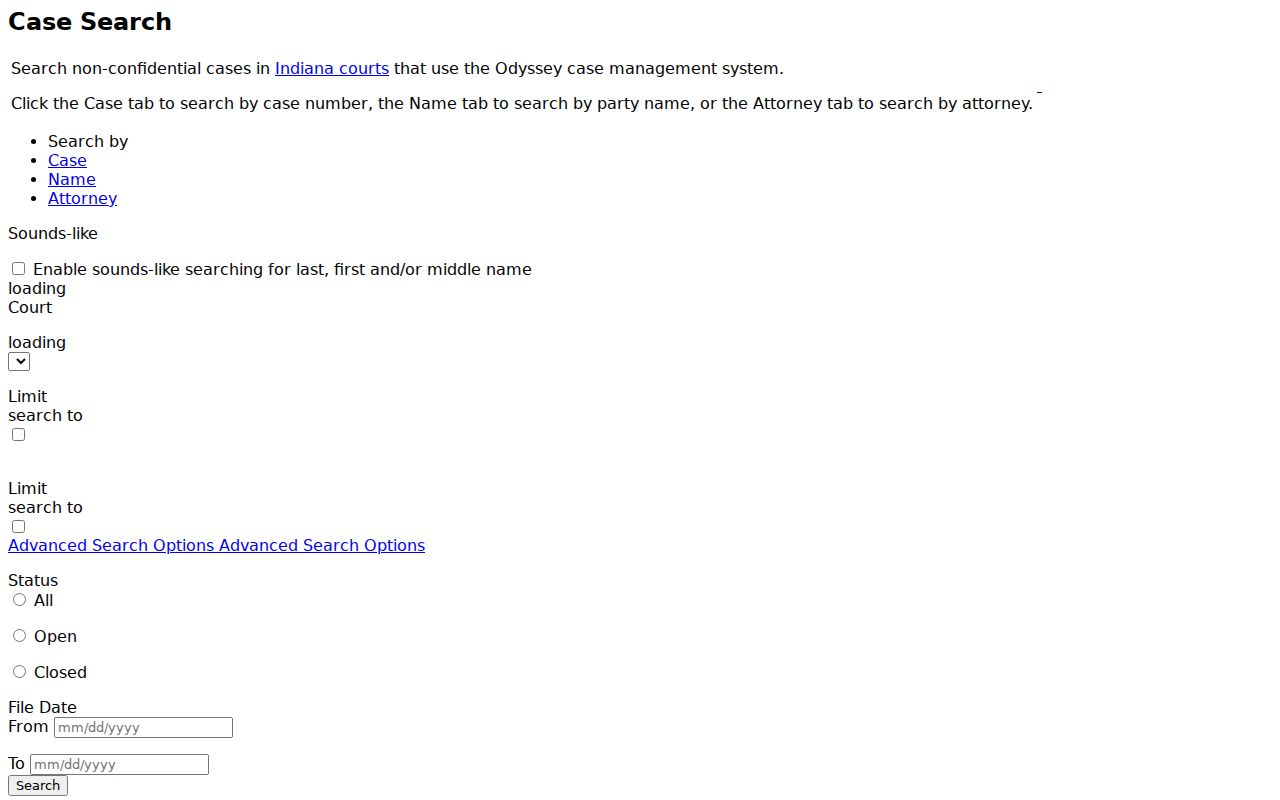
The form is just the starting point. The Pike County Clerk keeps the official local record. Online balances and hearing dates also need care. A payment entry does not prove a warrant was recalled, and a future hearing does not by itself cancel an earlier order. Ask the clerk which docket entry controls now and whether a later signed order exists.
What a Warrant Search Shows
A Pike County search can show the cause number, case type, filing status, court, public party data, events, hearings, orders, and some documents. A warrant-related event may reveal issuance or later court action. MyCase has no verified direct warrant-status field, though. Sheriff execution or return information may sit outside the court screen.
| Cause number | 63C01-YY-XXXX-000000 links the event to its underlying case |
|---|---|
| Alleged offense | Charge context, not a conviction or proof of guilt |
| Issuing court | Pike Circuit Court and a division or judicial officer if public |
| Bond | An amount and conditions set by rule or a case-specific order |
| Service or return | Agency action that may require a sheriff-record inquiry |
| Later action | Recall, quash, vacate, release, or another hearing if public |
No live person's record belongs here. The search fields show what to ask the Pike County Clerk about, while names, birth dates, addresses, and case narratives stay private.
Names Can Mislead a Pike Warrant Search
A name-only query can mislead. It may be too broad or too narrow. When a common name floods the results, add Pike Circuit Court, a birth date, or a known case number. Skip guessed facts. The sounds-like tool catches spelling variants. It can also mix unrelated people into the list. A missing match has many causes. The record may be sealed, confidential, juvenile, newly issued, historically incomplete, outside Pike County, or outside Indiana's state court system. Some public documents never get posted, even in Pike County, when a case caption appears. Let the clerk separate a weak search from the official record. Keep the inquiry narrow and civic. Search your own matter or an authorized public record to learn the proper court process. Do not republish private identifiers, photographs, mugshots, or lists of names. Pike County warrant lookup steps exist to help a person understand and address a court issue. They are not a private roster.
Where to Check Warrants in Pike County
Two offices split the work in Pike County. Pike Circuit Court and the Clerk of the Pike Circuit Court handle warrant issuance and the official docket. The Pike County Sheriff's Office handles execution, return, custody, the jail, and records requests. Petersburg, Winslow, and Spurgeon each have police agencies. The state directory lists no separate municipal court for any of them, so an arrest by a city officer still runs through the county's courts. For a traffic matter, check the court case first. A BMV status covers licensing and cannot show that Pike Circuit Court recalled a warrant. Federal cases sit in a different system entirely: Pike County belongs to the Southern District of Indiana, and public federal case records are searched through PACER. A sealed federal warrant may not appear publicly at all.
| Question | Official route |
|---|---|
| Was a warrant issued or recalled? | Pike Circuit Court Clerk |
| Was it served, returned, or tied to custody? | Pike County Sheriff |
| Is there a public case lead? | Indiana MyCase |
| Is there a traffic license consequence? | Indiana BMV after court review |
Pike Sheriff Record Requests Need Detail
The sheriff's official public-record request page takes requests by mail or in person, and a fee may apply. The form asks for the incident date, incident type, location, parties, record type, and an optional case or UTT citation number. It is not a dedicated warrant form, so be specific in what you ask for. Say whether you want a non-exempt execution, service, return, or custody record the sheriff holds. Give a date range and an identifier. Request a cost estimate too, since the sheriff's page posts no fixed local charge. Law-enforcement recordings go through a separate request route. A sheriff request also cannot change a judicial order. The criminal-history request page is not a Pike County warrant lookup either. It covers verified local arrest and booking information, and the page itself says it is not the actual criminal record or a record of charging decisions and outcomes. Inmate Search answers custody, not every warrant.
Restricted Warrants and Access Rules
Indiana's Access to Public Records Act governs many agency records, while court records follow the Indiana Rules on Access to Court Records. Access Rule 4 gives general access subject to exclusions. Rule 5 covers sealed cases, investigative requests, confidential filings, juvenile material, and other protected records. A search-warrant affidavit can be treated differently from an arrest-warrant event or a public return. When only part of a record is protected, ask for the reasonably segregable non-exempt portions. If a custodian denies or redacts your request in Pike County, ask which rule or statute supports that choice. Warrant records are neither wholly public nor wholly secret.
Access note: A sealed or confidential Pike County record may not appear publicly, and parties can have rights different from the general public.
When a Pike Warrant Result Appears
Do not rely on the screen alone. Save the cause number and note the relevant event, but keep personal data off public posts. Ask the clerk whether the entry is current and which division controls it. If a warrant may lead to custody, an Indiana lawyer can discuss a motion, a hearing, a bond question, or a planned appearance. Counsel can request a process but cannot guarantee no arrest or a particular court result. The issuing court alone controls recall, quashing, vacating, and other disposition. Paying money through a sheriff bond channel does not by itself prove the warrant disappeared. Pike County local rules and the sheriff payment page cover different parts of bond administration, and a live case can carry its own order, so confirm the exact amount, the terms, the permitted method, and the later docket entry. Keep receipts and filed copies. Ask when any recall or release order will reach the sheriff, because systems may not update at the same moment. Recheck the official docket after court action. Pike County runs no public warrant-amnesty event, no self-service recall form, and no no-arrest walk-in program. For a fuller account of court roles, bond limits, and safe resolution steps, the Pike County warrant records overview explains how the court and sheriff functions fit together.